
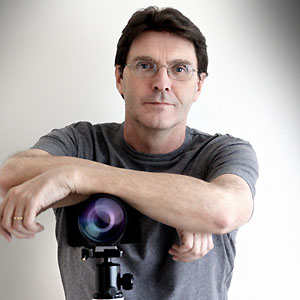
Jim specialises in travelling to his client's preferred locations throughout the UK and abroad, bringing with him all the necessary equipment.
With over 20 years' experience and having switched to digital photography in 1999, Jim is now recognised as an expert in digital imaging.
Hairstyle Photography is an area of fashion photography for which Jim is well known throughout the UK. Clients such as Wella, Schwarzkopf and L'Oreal along with many British Hairdressing Awards regional winners keep Jim constantly busy.
Jim works closely with salons all over the UK producing images for hairstyle magazines and national hairdressing competitions. Each year many of these salons become finalists in competitions such as L'Oreal Colour Trophy, Wella Trend Vision and the British Hairdressing Awards. Many clients have gone on to become winners with Jim's work. In 2004 one salon, Ishoka in Aberdeen, produced two winners at the British Hairdressing Awards, Scottish Hairdresser of the Year and Afro Hairdresser of the Year.
British Hairdressing Hall of Fame members Kathryn Longmuir, Paul Stafford and Tom Mulrine have all shot one or more winning collections with Jim.
General guidelines for hairstyle photography.
With over twenty years of hairstyle photography experience, Jim has plenty of advice for clients embarking on their first hair shoot.
It all starts with developing a concept for the shoot. The concept will then determine styles, location, make-up and the direction in which the photography should go. Magazines will want to see a theme running through the images so that they work well together on a page. These images will need hairstyling together with professional make-up and great clothes styling.
The order of importance of what makes a great shoot is MODEL, CLOTHES, MAKEUP, PHOTOGRAPHY, HAIR. You may be surprised to see that hair appears last. The bottom line is, brilliant hairstyling on a poor model produces poor photographic results whereas a great model will still photograph well even if the hair is not great.
Models
Professional models are a must for high-end shoots but if house models are being used then the following must be considered.
Bone structure is very important since the camera will add about 20 lbs (yes, that much). And remember skin and complexion should be excellent, there is only so much a good make-up artist can hide. Thin lips or lips that turn down slightly can give the appearance of sadness and should be avoided. Tall and thin are the operative words on these occasions.
Clothes styling
The Clothes Stylist can make or break the shoot, inexperience can lead to disaster. Great images are easier to get from unusual clothes or items of strange material used in place of clothes. Bare shoulders should be avoided on models that do not have the broad, square well defined shoulders of a super-model.
Even professional models can have blotchy skin on arms and legs, it is best to cover up as much as possible. Remember that a model appearing in Vogue or Elle over a five or six page shoot has been picked because she has flawless skin and a perfect body. However, a hairstyle shoot is likely to have four or more models and the chances of all of them having flawless arms, hands and legs is highly unlikely so it is best that your clothes stylist comes prepared with a variety of clothes that can cover up any problem areas.
Jewellery is a tricky one. You will see looking through hairstyle magazines that very few of the models are wearing jewellery as this only distracts the viewer away from the hair. Jewellery should only be used if it is required to achieve a desired effect for a particular concept and in such cases over sized costume jewellery is best.
Make-up
Imaginative and striking make-up which suits the feel and theme of a shoot can produce excellent results but an attempt by an inexperienced make-up artist to produce avant garde looks can be disastrous. The safest option for an inexperienced make-up artist is to make the model look attractive without trying anything too adventurous. Foundation may need to be heavy (but not dark) to cover up all blemishes and lipstick must be absolutely perfectly applied.
Photography
Before the shoot Jim will discuss the concept with you. Location shoots in or around buildings with unusual architecture can produce great results.
Shoots can be done in your salon too if there is a clear area of at least 20 feet by 12 feet. The advantage of this is that you will have everything that you need within easy reach. Jim will bring studio lighting and backgrounds with him.
On average you would try to achieve two looks per model. All cutting and colouring should take place before Jim arrives so as to keep "down time" to a minimum. Make-up can be under way while Jim sets up and then you should only need to dress the hair and start shooting. Most hairstylists with photo shoot experience work fast and dress hair to camera sometimes requiring literally 5 minutes to achieve another look. These stylists can sometimes get up to 3 or 4 very different looks from one model in a very short time.
Do not book all of your professional models to arrive at the same time, for example, it is best to have two in the morning for a half day and two arriving at 12.30 for the remainder of the day.
Hair styling
Jim cannot tell you how to style hair but years of experience in hairstyle photography has taught Jim what gets published and what doesn't.
Context is important, try not to create a hairstyle on a model if her face, clothes and make-up do not represent the kind of person who would wear their hair that way.
It is important not to overwork the hair to the point where the model becomes tired and wishes she could escape. Non-professional and even some professional models can perform badly for the camera if they feel the hairstyle diminishes their sense of attractiveness. Remember that most of the time the camera will only see the front of the hair making the back irrelevant. Over use of hair spray causes problems, use scissors to snip off the odd hair sticking out of place.